A commercial overhead door is checked by looking and listening every month, with a trained technician visiting once a year, and the springs, cables and tracks are left to that technician. Advanced Overhead Garage Door Company installs and repairs commercial sectional, rolling steel and coiling doors across Northern Nevada, and we provide maintenance and tune-ups with free estimates.
Key points
- The industry association DASMA recommends monthly safety checks and an annual visit from a trained door systems technician
- Staff should look and listen, not adjust
- Spring cycle life may not coincide with door cycle life, per DASMA TDS 190
- The federal safety agency advises inspecting the door and opener every 30 days
- Call for service on any door that sticks, drifts or makes a new noise
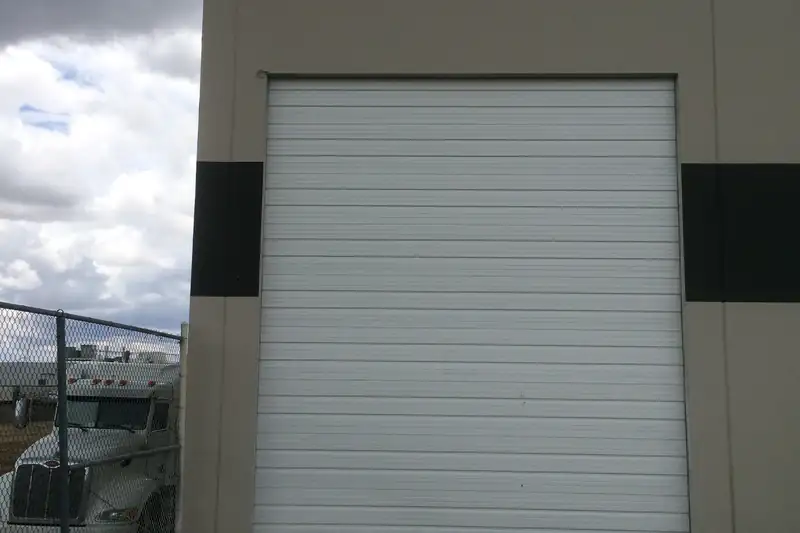
A business door opens and closes far more than a house door, and a stuck door can stop a day's work. This guide covers what your staff can safely look at, what a maintenance visit covers, and how dock and rolling doors differ.
Why busy doors wear faster
Wear follows use. A door that opens many times a day at a warehouse, showroom, school or dealership runs its rollers, hinges, cables and springs through far more cycles than a house door. The Door and Access Systems Manufacturers Association says in its technical data sheet 190 that spring cycle life may not necessarily coincide with door cycle life, which means a door can outlast or fall short of its springs depending on how it is built and used. The sheet gives no single cycle number, and we would not name one for your door without looking at it.
The practical point is that a busy door earns its maintenance. Planned visits catch worn parts before they fail in the middle of a delivery.
What shortens spring life on a business door
DASMA's technical data sheet 190 lists usage factors that matter most on commercial doors. Doors left open for long periods on a regular basis expose their springs to more temperature, moisture and air-quality swings, and doors in climates with extreme heat or cold should be kept closed where possible. Certain chemicals, such as acids containing chlorine, can corrode springs, and the sheet names wash bays as an application to review for corrosive effects.
The same sheet warns that adding weight to a door, for example with paint or attached materials, can push it past the maker's specifications, and that the counterbalance assembly should be maintained according to the door manufacturer's written instructions. A sign bolted to a dock door or a fresh coat of paint is worth mentioning when we visit.
Daily and monthly checks for staff
Staff are the first to notice when a door changes. The checks below are for looking and listening only. The U.S. Consumer Product Safety Commission's guidance advises inspecting the door and opener every 30 days, and DASMA recommends monthly safety checks by the owner.
Do not adjust, tighten or loosen springs, cables, drums or the brackets that hold them. Those parts are under high tension, and DASMA says spring systems are dangerous and should be repaired only by trained professionals.
- Does the door open and close smoothly, without jerking or drifting?
- New noises: grinding, scraping or squealing
- Gaps, bends or crooked sections along the door
- Frayed or loose cables, or a cable that looks out of place
- Photo eyes or sensors blocked, dirty or knocked out of line
- Seals along the bottom or sides that are torn or hanging
- Tag any door that behaves differently and stop using it
The CPSC also describes what a properly operating door looks like: it is balanced, so it stays in place when stopped partly open. A door that is not balanced, or that binds or sticks, should be serviced by a professional.
What a maintenance visit covers
On a visit, a qualified, friendly technician inspects the full door system, tests balance and safety reversal, looks at springs, cables, rollers, hinges, tracks and weather seals, and checks the opener and its controls. Worn parts are found early and the door is brought back to smooth operation. We tell you what we find, give you a free estimate on any repair and do the work with a guarantee on all our work.
See our pages on garage door tune-up and maintenance and commercial garage door repair.
Ask the technician to explain anything you do not understand, and keep the visit notes. Each door has its own history, and the notes help the next visit start where the last one ended.
Dock doors and rolling doors
Sectional doors are the panel-style doors that lift overhead on tracks, while rolling steel and coiling doors wind onto a barrel above the opening. Each type has its own wear points, and both are part of our commercial work: we install and repair a large variety of commercial garage doors, sectional garage doors and rolling steel doors, including coiling, sectional, insulated and non-insulated doors, high-lift and vertical-lift doors, and full view and raised panel doors.
Loading docks, warehouses, storage facilities, showrooms, fire departments and schools all lean on their doors differently. See rolling steel doors, commercial sectional doors and commercial garage door repair.
Making it routine
A simple routine works well: staff check the door each month and write down anything unusual, and a technician visits once a year. When something changes between visits, call right away. Emergency and same-day service is available 24/7 at 775-356-0444, and you can request a free estimate online.
If you manage several buildings or a fleet bay, keep a short note for each door of what was checked and when, with your facility records. It makes the next visit faster and shows which doors are working hardest.
Sources (3)
- DASMA (Door & Access Systems Manufacturers Association): dasma.com/wp-content/uploads/2021/12/TDS190.pdf (checked November 2026)
- DASMA (Door & Access Systems Manufacturers Association): dasma.com/safety-tips/ (checked November 2026)
- U.S. Consumer Product Safety Commission: cpsc.gov/s3fs-public/garage.pdf (checked November 2026)