Wayne Dalton says the most common garage door sizes come in widths from 8 to 18 feet, and doors are made to fit an opening, so the size comes from measuring yours. Advanced Overhead Garage Door Company sells and installs residential and commercial garage doors across Northern Nevada, and we measure your opening as part of a free estimate.
Key points
- Common garage door widths run from 8 to 18 feet, per Wayne Dalton
- RV, shop and commercial openings are larger and often made to order
- Measure width, height, headroom, side room and room depth
- Write down what you measured and send us photos for a free estimate
- Never take a door apart to measure it; springs and cables hold stored energy
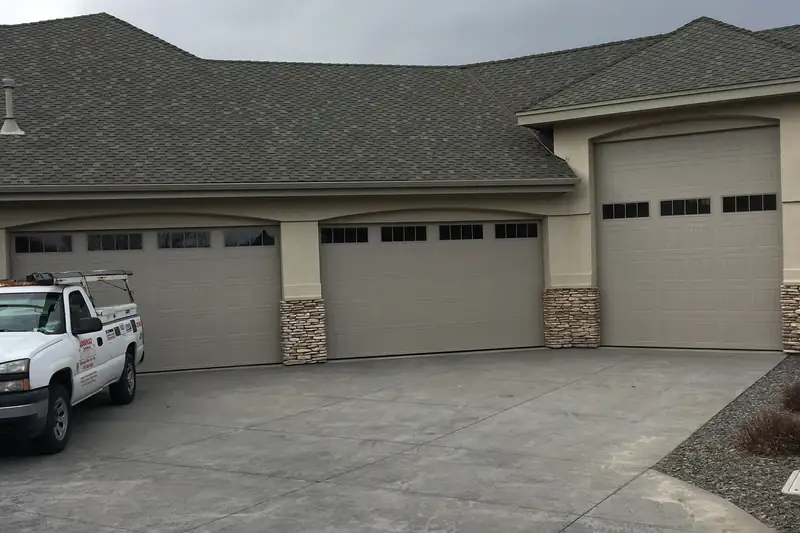
Garage doors are made to fit an opening, so the first question on any new door is the size. This guide gives the common sizes, the measurements that matter, and why a door is ordered for your opening rather than taken off a shelf.
Standard sizes
Most homes have a one-car or two-car door. Wayne Dalton's sizing guide says the most common garage door sizes come in widths that vary from 8 feet to 18 feet, and that choosing the right size takes more than measuring the width of the opening. Its published insulation figures for Classic Steel Models 9100 and 9605 are given for 7-foot and 8-foot tall doors.
A door can be made in other widths and heights, so a size that is not common is not a problem; it simply means the door is ordered to fit.
RV, shop and commercial sizes
RV garages, workshops and barns often need taller or wider doors than a house does. Doors for these buildings are normally made to order for the opening.
On the business side, we install and repair a large variety of commercial garage doors, sectional garage doors and rolling steel doors, including specialized coiling, sectional, insulated and non-insulated doors, doors that can be high lifted, and vertical lift, full view and raised panel doors. They go into a commercial warehouse, pole barn or most other commercial structure. See commercial sectional doors and rolling steel doors.
How to measure your opening
You need a tape measure, a notepad and a few minutes. Measure the finished opening from the inside, with the old door closed, and do not remove or loosen anything on the old door. The springs, cables and brackets on the old door are under tension, so measuring is a look-only job.
- Width: measure the opening from the left jamb to the right jamb at the widest point.
- Height: measure from the floor to the top of the opening, to the header.
- Headroom: measure from the top of the opening up to the ceiling or the lowest obstruction, such as a beam, pipe or light.
- Side room: measure the open wall space to the left and right of the opening, since the track and hardware sit there.
- Room depth: measure from the opening back into the garage to the back wall, or to the first shelf or object in the way, so the door and opener have space to travel.
Take photos of the inside of the garage from the doorway and of the header area. Photos help us give an accurate free estimate; use the photo upload on our free estimate page.
Door size and the opener
The door's size and weight also decide the opener. Wayne Dalton's sizing guide says most garage door sizes need an opener of 1/3 to 1 horsepower, that most homes use 1/2 horsepower, and that larger, heavier doors usually need at least one horsepower. It gives the example that a single door of uninsulated steel needs only 1/3 horsepower.
The same guide reminds you to measure the opening in several places, because an unlevel floor shows up as a different height from one side to the other, and to measure room depth only to the first shelf or object on the back wall. If you are replacing the opener at the same time, see our guide to choosing an opener; we are an authorized LiftMaster dealer.
Why doors are made to size
Door openings are not identical from house to house. Framing, trim and slab height all vary, and a door has to fit tightly enough to seal and move freely on its track. That is why we measure the actual opening rather than guess from the house style.
We research the very best products in each price category, and we proudly feature Wayne Dalton garage doors and LiftMaster garage door openers. We aim for doors that are tough, dependable and long lasting, built to handle the challenging weather of the Greater Reno area and all of Northern Nevada. See residential garage doors and the new garage door cost guide for what affects a total.
What Advanced Overhead does
We provide free estimates, install new residential and commercial doors, and replace or repair what is already there. We guarantee all our work, and emergency and same-day service is available 24/7. Call 775-356-0444.
Sources (2)
- Wayne Dalton: wayne-dalton.com/resources/what-you-need-to-know/how-to-determine-the-right-size-garage-door (checked November 2026)
- Wayne Dalton: wayne-dalton.com/garage-doors/detail/classic-steel-garage-doors-9100-9605 (checked November 2026)