Pick the drive type to match your garage: a belt or chain opener for a standard ceiling, a wall-mount opener when headroom is tight or the ceiling is high. Advanced Overhead Garage Door Company, an authorized LiftMaster dealer, installs new openers and can help you choose with a free estimate at 775-356-0444.
Key points
- Chain, belt and wall-mount are the main designs; the right one depends on your garage
- Every new residential opener sold in the U.S. has entrapment protection by federal rule
- LiftMaster recommends replacing openers made before 1993 rather than repairing them
- Battery backup and smart features are add-on decisions, not safety must-haves
- A new opener does not fix a broken spring
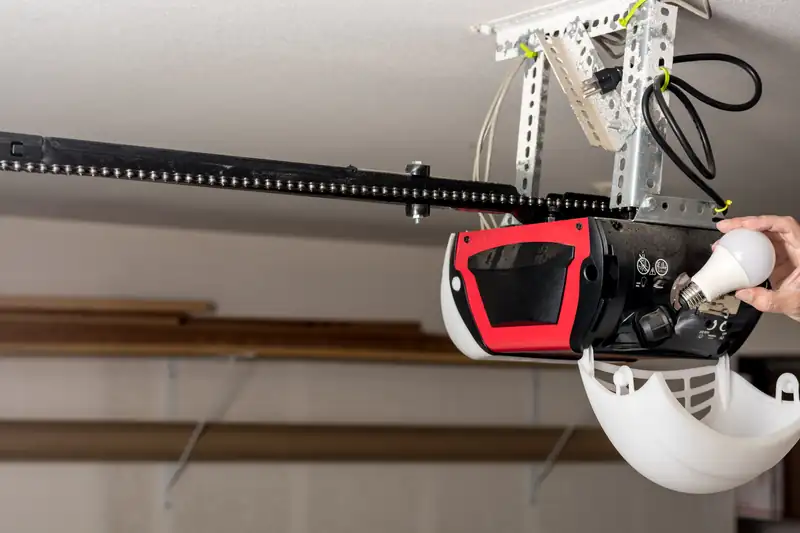
Openers look similar from the floor, but the drive type, mounting and features change how one sounds, what it needs from your garage and what it does for you. This guide compares the main choices in plain terms and leaves prices to a free estimate.
Drive types compared
The drive is the part that moves the door's trolley along the rail. The differences below are general, and the best fit for your garage comes down to what is above and beside the door.
| Drive type | How it moves the door | Typically a good fit when | Worth knowing |
|---|---|---|---|
| Chain | A metal chain along a ceiling rail pulls the trolley | The garage is detached or you want a straightforward, proven design | Tends to be louder than a belt |
| Belt | A reinforced belt along a ceiling rail | A bedroom or living space is next to or above the garage | Generally the quieter ceiling-rail choice |
| Wall-mount | The motor sits on the wall beside the door and turns the torsion bar; no ceiling rail | The ceiling is high, the headroom is tight or you want to keep the ceiling free | Works with a torsion spring system, so check which springs you have |
Not sure which springs you have? Our guide to torsion and extension springs explains how to tell by looking.
Wall-mount for low or high ceilings
A ceiling-rail opener needs room above the door and a place to hang the rail. A wall-mount design frees the ceiling, which helps in garages with tall ceilings, storage racks, a loft, or a low ceiling where a rail leaves little space. It is also a way to put a lighting or storage plan in the center of the ceiling.
Because the motor turns the bar the springs are on, it is a good match for doors with torsion springs. A technician can see on site whether your door and wall suit one. We show you the options during the free estimate.
Battery backup and smart features
A battery-backup opener keeps working in a power cut, which saves you the manual release. Our guide on opening a garage door in a power outage covers what to do if yours does not have it.
Smart features let you open, close and check the door from a phone, useful for deliveries or a second home. See our guide to LiftMaster myQ and the smart garage for what is involved. Keypads and remotes are separate add-ons; see remotes and keypads.
Safety features every new opener has
The U.S. Consumer Product Safety Commission announced in December 1992 that entrapment-protection requirements apply to openers manufactured on or after January 1, 1993, which in practice means the photo eyes near the floor and a reversing door. A 2016 update to the rule (Federal Register 2016-07552, 16 CFR 1211.8(c)) says the operator shall monitor for the presence and correct operation of the device at least once during each close cycle.
LiftMaster states that all of its garage door openers comply with the UL 325 safety standard, and it recommends replacing openers made before 1993 rather than repairing them, since those units predate the federal entrapment rule. If yours is that old, replacement is the safer path. Whatever you choose, run the monthly safety reversal test.
What changes the price of an opener installation
We publish no opener prices, because the installed price depends on choices you make and on the door the opener has to lift. These are the things that move it:
- Drive type: chain, belt or wall-mount
- Motor power, matched to the weight and size of the door
- Battery backup, so the door can run during a power outage
- Smart control through the myQ app
- Keypad, wall control and the number of extra remotes
- Rail length or extension for a tall door
- Wiring, mounting and the safety sensors the installation requires
- Removal and haul-away of the old unit
The safety sensors are part of a correct installation, not an extra: every new residential opener has to carry entrapment protection, and a proper install includes mounting and aiming the photo eyes, wiring them and testing that the door reverses.
How to compare opener quotes
Ask each company to name the model, the drive type and the motor power, then compare like with like. A quote that does not say whether it includes safety sensors, wiring, a keypad, extra remotes, a battery backup or removal of the old opener is not a complete price. Ask whether the rail length fits your door height, and ask what the warranty on the opener and on the work covers.
It also helps to separate the opener from the door. If the door is out of balance or a spring is failing, a new opener will strain against it, so a good technician checks the door first. A tune-up before or alongside a new opener is often sensible.
What we do
We install new garage door openers as an authorized LiftMaster dealer, and we repair openers of various brands, backed by over 14 years of experience working on various brands of garage doors. We guarantee all our work and we offer free estimates. See LiftMaster garage door openers and opener repair for more.
Bring a few details to the estimate: the age of your current opener, whether the garage is attached to living space, and how high the ceiling is. A photo of the ceiling above the door and the wall beside it helps us tell you whether a ceiling rail or a wall-mount design fits, and whether the opener you have now is worth repairing or ready to replace. Our qualified, friendly technicians explain the choices in plain terms and leave the decision to you.
Sources (3)
- LiftMaster: liftmaster.com/about-liftmaster/safety (checked November 2026)
- U.S. Consumer Product Safety Commission: cpsc.gov/Newsroom/News-Releases/1993/Safety-Commission-Publishes-Final-Rules-For-Automatic-Garage-Door-Openers (checked November 2026)
- Federal Register: govinfo.gov/content/pkg/FR-2016-04-07/html/2016-07552.htm (checked November 2026)